Thai Months and Days of the Week: The Complete Learner's Guide
If you are learning Thai and have ever looked at a Thai calendar, two things probably hit you at once: the month names are long and unfamiliar, and the year number is about 543 years ahead of what you expected. This guide explains both — and gives you every month and weekday in Thai script, pronunciation, and meaning so you can read a Thai calendar with confidence.
The short version: Thai month names are Sanskrit zodiac names coined in 1889, Thai day names come from ancient Indian planetary astrology, and the Buddhist Era (B.E.) used for year numbers is simply the Gregorian year plus 543.
The 12 Thai Months
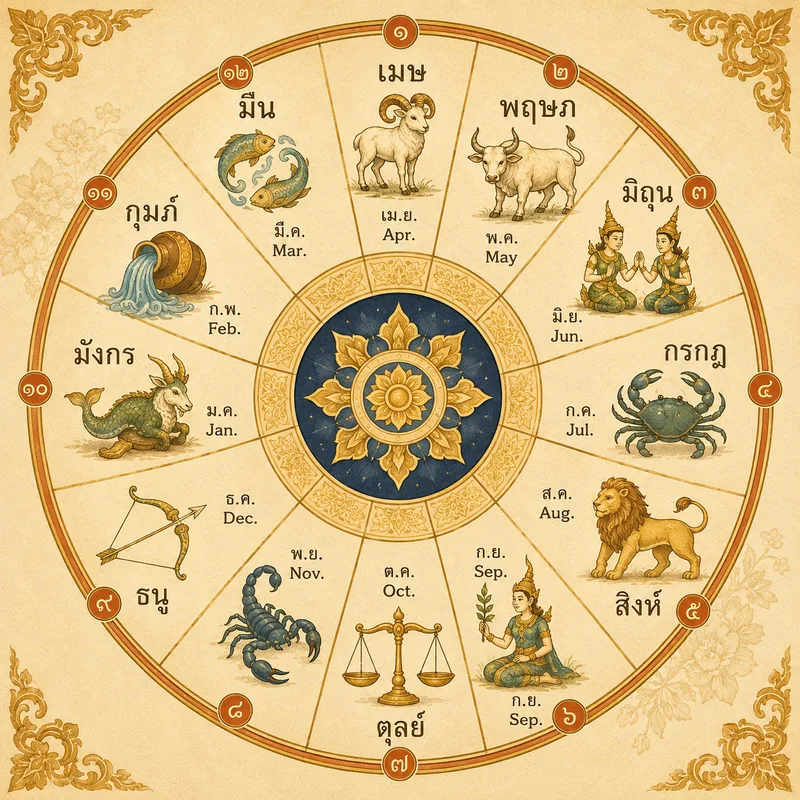
Thai month names look intimidating when you first see them, but they follow a single elegant pattern: each name encodes the zodiac sign the sun enters during that month. Every name is built from a Sanskrit zodiac root plus a learned Thai suffix — either -าคม (meaning "arrival") or -อายน (meaning "approach/coming to").
That structure also gives you a built-in mnemonic for how many days each month has:
- Months ending in -คม have 31 days
- Months ending in -ยน have 30 days
- กุมภาพันธ์ (February) is the lone exception: 28 days, or 29 in a leap year
Thai schoolchildren still learn this rule today. It works for ten of the twelve months without exception.
| Thai month | Transliteration | Gregorian month | Zodiac meaning | Days |
|---|---|---|---|---|
| มกราคม | mók-gà-raa-kom | January | Capricorn (Makara — the sea-creature) | 31 |
| กุมภาพันธ์ | gum-paa-pan | February | Aquarius (Kumbha — the water jar) | 28/29 |
| มีนาคม | mii-naa-kom | March | Pisces (Mīna — the fish) | 31 |
| เมษายน | mee-sǎa-yon | April | Aries (Meṣa — the ram) | 30 |
| พฤษภาคม | prʉ́t-sà-paa-kom | May | Taurus (Vṛṣabha — the bull) | 31 |
| มิถุนายน | mí-tù-naa-yon | June | Gemini (Mithuna — the pair) | 30 |
| กรกฎาคม | gà-rá-gà-daa-kom | July | Cancer (Karkaṭa — the crab) | 31 |
| สิงหาคม | sǐng-hǎa-kom | August | Leo (Siṃha — the lion) | 31 |
| กันยายน | gan-yaa-yon | September | Virgo (Kanyā — the maiden) | 30 |
| ตุลาคม | dtù-laa-kom | October | Libra (Tulā — the scales) | 31 |
| พฤศจิกายน | prʉ́t-sà-jì-gaa-yon | November | Scorpio (Vṛścika — the scorpion) | 30 |
| ธันวาคม | tan-waa-kom | December | Sagittarius (Dhanu — the bow/archer) | 31 |
A quick note on the suffix rule
Check the ending of any month name: มกราคม, มีนาคม, พฤษภาคม — all end in -คม, all 31 days. เมษายน, มิถุนายน, กันยายน, พฤศจิกายน — all end in -ยน, all 30 days. February, กุมภาพันธ์, breaks both patterns with its unique -พันธ์ ending — a useful visual cue that it is the exception.
Why these names and not others?
All twelve names were introduced together in 1889 when Siam adopted the solar calendar. Prince Devawongse Varopakarn created the system to align Thai usage with the international calendar while keeping an Indic-astrological framework. Before that, Thais in the Rama IV era sometimes just transliterated Western month names into Thai script.
One cultural connection worth knowing: the festival of สงกรานต์ (Songkran), Thailand's traditional New Year celebrated around 13 April, is tied to the same zodiac logic — it marks the sun moving into Aries (เมษา/เมษ, Meṣa).
The 7 Days of the Week in Thai
Thai weekday names are far older than the modern month names. They come from the ancient Indian planetary week — the same system that gave English "Saturday" (Saturn), "Sunday" (Sun), and "Monday" (Moon). Each Thai day is named after one of the seven classical luminaries of Indic astrology.
On a Thai calendar each day has a standard single-character abbreviation. Listed Monday-first — the order RianThai's calendar uses — they are จ อ พ พฤ ศ ส อา. (Many traditional Thai calendars instead start the week on Sunday, so you will also see them as อา จ อ พ พฤ ศ ส.)
| Thai day | Transliteration | English day | Named after | Meaning |
|---|---|---|---|---|
| วันจันทร์ | wan jan | Monday | The Moon (Candra) | "The shining one" |
| วันอังคาร | wan ang-kaan | Tuesday | Mars (Aṅgāra) | "Charcoal / burning coal" — Mars's red color |
| วันพุธ | wan pút | Wednesday | Mercury (Budha) | Linked with intelligence |
| วันพฤหัสบดี | wan prʉ́-hàt-sà-bɔɔ-dii | Thursday | Jupiter (Bṛhaspati) | "Lord of prayer" — the teacher deity |
| วันศุกร์ | wan sùk | Friday | Venus (Śukra) | "Bright, clear, shining" |
| วันเสาร์ | wan sǎo | Saturday | Saturn (Saura) | "Son of the Sun" — a Saturn-family name |
| วันอาทิตย์ | wan-aa-tít | Sunday | The Sun (Āditya) | "Son of Aditi" — a solar deity |
The names are not just historical curiosities. They are still fully alive in everyday speech. Thais use wan-aa-tít and wan pút the way English speakers use "Sunday" and "Wednesday" — no one thinks about planets when making weekend plans. But knowing the origins helps the names stick when you are learning them.
One pronunciation note: วันพฤหัสบดี is a mouthful in full, so in everyday conversation Thais often shorten it to วันพฤหัส (wan pá-ò-hàt).
Thai Day Colors
Each day of the week in Thai culture has an associated color. You will see these colors on birthday-color merchandise, temple offerings, commemorative shirts, and government ceremony graphics. They come from ancient navagraha (nine-planet deity) astrology, but in modern popular culture they have been standardized into a simple, memorable set.
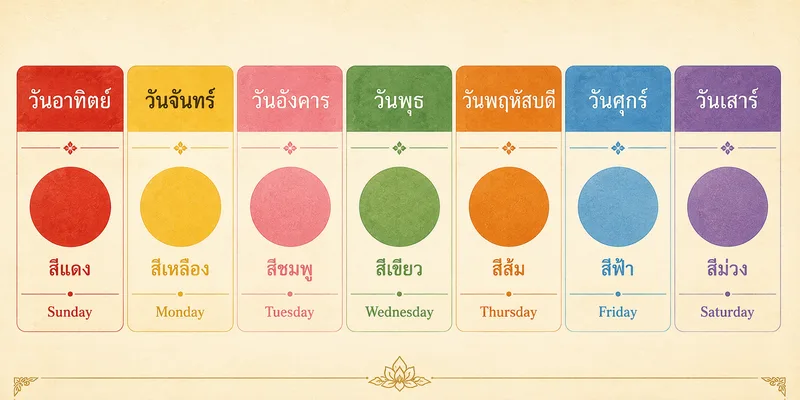
| Day | Thai | Popular color | Color name in Thai |
|---|---|---|---|
| Monday | วันจันทร์ | Yellow | สีเหลือง |
| Tuesday | วันอังคาร | Pink | สีชมพู |
| Wednesday | วันพุธ | Green | สีเขียว |
| Thursday | วันพฤหัสบดี | Orange | สีส้ม |
| Friday | วันศุกร์ | Blue | สีฟ้า |
| Saturday | วันเสาร์ | Purple | สีม่วง |
| Sunday | วันอาทิตย์ | Red | สีแดง |
Older variants
The popular set above is what you will find on most school posters and commercial products today. Older astrological sources — including Fine Arts Department materials on the navagraha deities — use slightly different colors in some cases:
- Monday may be white or cream (สีขาว) rather than yellow, depending on the source.
- Saturday in classical planetary descriptions is traditionally black (สีดำ), not purple. Purple is the modern popular substitute, likely adopted because it is more cheerful for classroom use.
- Friday appears as pale sky-blue (สีฟ้าอ่อน) in some learned sources and as deeper navy-blue in others.
Neither set is "wrong" — they reflect different layers of the same tradition. If you see a Thai wearing a particular color on a certain day, it is almost certainly the popular modern set that guided the choice.
Why colors matter beyond horoscopes
Day colors are visible in Thai public life in ways that go beyond personal fortune-telling. Yellow shirts and yellow flags are associated with Monday because the king whose reign shaped modern Thai royal culture was born on a Monday. Government commemorative arches, official insignia, and state celebration graphics routinely invoke birth-day colors as part of royal symbolism. This is why knowing the day colors is genuinely useful cultural literacy, not just trivia.
Buddhist Era (B.E.) vs. Gregorian Calendar
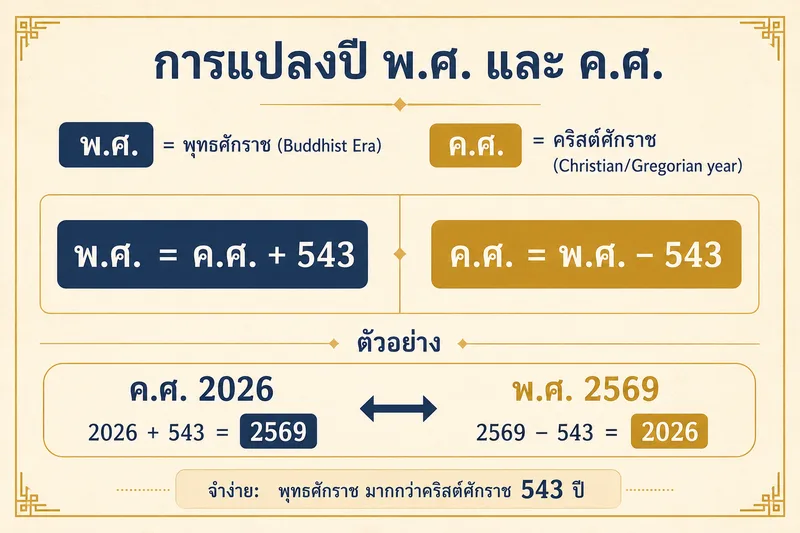
Open any Thai document — a contract, a government form, a train ticket — and the year will almost certainly be written as พ.ศ. (พุทธศักราช, Buddhist Era), not A.D. The difference is 543 years.
The rule: B.E. = A.D. + 543
So the year 2026 A.D. is พ.ศ. 2569 in Thailand. The year 2000 A.D. was พ.ศ. 2543.
To convert in the other direction: A.D. = B.E. − 543
This holds for all dates from 1 January 1941 onward, which covers every living person's documents and essentially all modern contexts you will encounter as a learner.
Want to skip the arithmetic? Use RianThai's Thai Calendar & Date Converter — type any year in either era and it converts instantly, with a full Thai calendar showing weekday and month names in Thai script.
Why 543?
The Buddhist Era counts from the year of the Buddha's parinirvana (passing into final nirvana), following a specific Thai-Khmer-Lao calendrical convention in which B.E. 1 begins after a full year has elapsed from that event. The result is the 543-year offset from the Gregorian year.
A brief history of the Thai calendar
Three reforms shaped the system you see today:
1889 — Siam switched from its old lunar-based official calendar to the solar calendar, set 1 April as New Year's Day, and introduced the twelve zodiac-based month names that are still used today.
1912 — A Royal Gazette proclamation replaced the Rattanakosin Era (which counted years from the founding of Bangkok) with the Buddhist Era for all official documents.
1940/1941 — The Calendar Act moved Thai New Year from 1 April to 1 January, effective 1 January 1941. This created the famous nine-month year: พ.ศ. 2483 ran only from April through December 1940, because January–March of that calendar year had already been counted as พ.ศ. 2482 under the old system. If you ever see a Thai historical document dated พ.ศ. 2483, it refers to a year with only nine months.
One edge case worth knowing: for Thai civil dates before 1 January 1941 that fall in January, February, or March, the conversion is A.D. = B.E. − 542 (not 543), because under the old April-start system, those months belonged to the previous Thai year. For anything after 1941 — all modern practical use — the straightforward ± 543 rule applies.
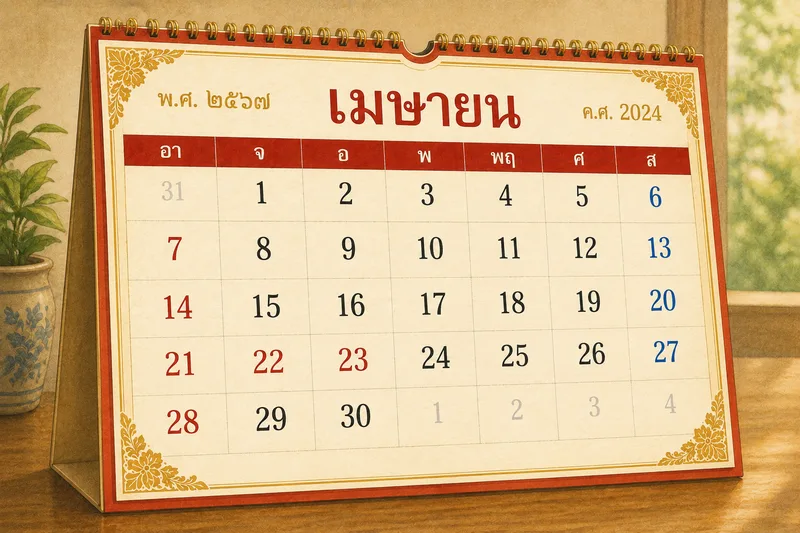
How to Use This on a Real Calendar
Thai calendars display a lot of information in a compact space. Here is what to look for:
- The year at the top will be written as พ.ศ. ____ — subtract 543 to get the Gregorian year.
- Column headers are the seven day abbreviations: จ อ พ พฤ ศ ส อา — Monday through Sunday.
- Month names at the top of each monthly grid are the zodiac names from the table above. After a few weeks of using a Thai calendar, มกราคม and ธันวาคม will feel as natural as January and December.
A useful shortcut: the first two syllables of each month name are enough to identify it in conversation. มกรา- for January, กุมภา- for February, มีนา- for March, and so on. Thais commonly use these shortened forms in speech.
Better yet, practise on a real one. RianThai's interactive Thai Calendar & Date Converter lays out the whole year as a Thai calendar — weekday columns, Thai month names, and the B.E. year — right next to a year converter, so you can read live Thai dates while everything on this page is still fresh.
Quick Reference Summary
Month length rule: -คม = 31 days, -ยน = 30 days, กุมภาพันธ์ = 28 or 29 days.
Weekday abbreviations (Monday-first): จ อ พ พฤ ศ ส อา
Day colors (popular modern set): yellow, pink, green, orange, blue, purple, red — Monday to Sunday.
Year conversion: B.E. = A.D. + 543. Thai year พ.ศ. 2569 = 2026 A.D.
Once you have the month names and day names down, reading a Thai calendar becomes straightforward. Use the tables above as a reference and come back whenever you need a quick reminder — within a few months of regular exposure to Thai text, these names will stick on their own.