







































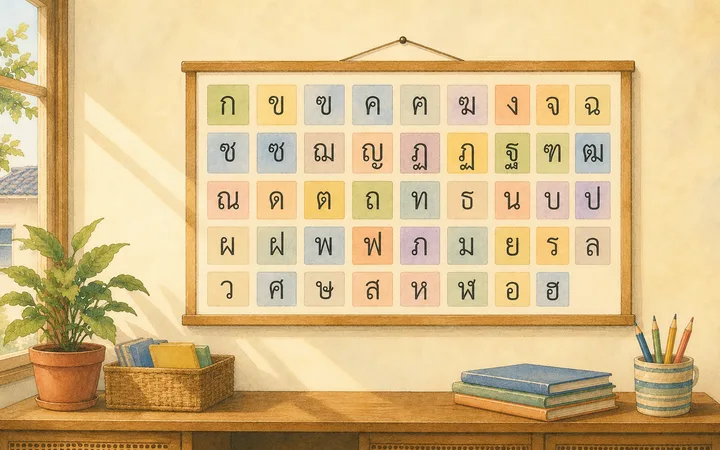
Thai alphabet
Open flashcards →
The Thai alphabet has 44 consonants, 18 vowel forms, and 4 tone marks. Each consonant belongs to one of three classes — high, mid, or low — which determine the tone of a syllable.
Every Thai consonant belongs to one of three classes — high, mid, or low. These classes are not about pronunciation: they determine the tone of a syllable when no tone mark is written. For example, a syllable starting with a mid-class consonant and ending in a stop (like ก, บ, ด) gets a low tone, while the same pattern with a low-class consonant gets a high tone. Mastering the classes is therefore essential for reading Thai correctly.
Although Thai has 44 consonant letters, only 9 sounds are permitted at the end of a syllable: the stops /k/, /p/, /t/ (pronounced without release), the nasals /m/, /n/, /ŋ/, and the glides /j/ and /w/. Many consonants that sound different at the start of a word share the same final sound — for instance, ด, ต, ถ, ท, ธ, ศ, ษ, ส all reduce to /t/ in final position.
These are composite consonant-vowel symbols, not part of the 44-consonant alphabet. Each combines a consonant with a built-in vowel sound.
Composite letter (ร + vowel). Common in words like ฤดู "season", อังกฤษ "England". Pronounced /rɯ/, /ri/, or /rəː/ depending on the word.
Obsolete composite letter (ล + vowel). Historically parallel to ฤ but with ล. Not used in modern Thai.
Thai vowels come in short and long pairs. They can appear before, after, above, or below a consonant.
◌ represents the position of a consonant
Thai has 5 tones: mid, low, falling, high, and rising. Four tone marks are used in writing.