Numbers from 0 to 10
| Arabic number |
Thai number |
Name | Transliteration/ Romanization |
Translation |
|---|---|---|---|---|
| 0 | ๐ | ศูนย์ | sǔun | zero |
| 1 | ๑ | หนึ่ง | nʉ̀ng | one |
| 2 | ๒ | สอง | sɔ̌ɔng | two |
| 3 | ๓ | สาม | sǎam | three |
| 4 | ๔ | สี่ | sìi | four |
| 5 | ๕ | ห้า | hâa | five |
| 6 | ๖ | หก | hòk | six |
| 7 | ๗ | เจ็ด | jèt | seven |
| 8 | ๘ | แปด | bpɛ̀ɛt | eight |
| 9 | ๙ | เก้า | gâao | nine |
| 10 | ๑๐ | สิบ | sìp | ten |
How to write Thai numbers from 1 to 10 (video)
From 10 to billions
| Arabic number |
Thai number |
Name | Transliteration/ Romanization |
Translation |
|---|---|---|---|---|
| 10 | ๑๐ | สิบ | sìp | ten |
| 11 | ๑๑ | สิบเอ็ด | sìp-èt | eleven |
| 12 | ๑๒ | สิบสอง | sìp-sɔ̌ɔng | twelve |
| 13 | ๑๓ | สิบสาม | sìp sǎam | thirteen |
| 20 | ๒๐ | ยี่สิบ | yîi-sìp | twenty |
| 21 | ๒๑ | ยี่สิบเอ็ด | yîi sìp-èt | twenty one |
| 22 | ๒๒ | ยี่สิบสอง | yîi sìp-sɔ̌ɔng | twenty two |
| 30 | ๓๐ | สามสิบ | sǎam-sìp | thirty |
| 31 | ๓๑ | สามสิบเอ็ด | sǎam sìp-èt | thirty one |
| 32 | ๓๒ | สามสิบสอง | sǎam sìp-sɔ̌ɔng | thirty two |
| 100 | ๑๐๐ | ร้อย | rɔ́ɔi | hundred |
| 1000 | ๑๐๐๐ | พัน | pan | thousand |
| 10000 | ๑๐๐๐๐ | หมื่น | mʉ̀ʉn | ten thousand |
| 100000 | ๑๐๐๐๐๐ | แสน | sɛ̌ɛn | hundred thousand |
| 1000000 | ๑๐๐๐๐๐๐ | ล้าน | láan | million |
| 1000000000 | ๑๐๐๐๐๐๐๐๐๐ | พันล้าน | pan láan | billion |
Ordinal numbers
In Thai, ordinal numbers indicate the position or order of items, people, or things in a sequence. Unlike cardinal numbers, which represent quantity (e.g., one, two, three), ordinal numbers denote the order or rank (e.g., first, second, third). Here are the Thai ordinal numbers for the first ten positions:
| 1 | ที่ หนึ่ง | tîi-nʉ̀ng | first |
| 2 | ที่ สอง | tîi-sɔ̌ɔng | second |
| 3 | ที่ สาม | tîi-sǎam | third |
| 4 | ที่ สี่ | tîi-sìi) | fourth |
| 5 | ที่ ห้า | tîi hâa | fifth |
| 6 | ที่ หก | tîi-hòk | sixth |
| 7 | ที่ เจ็ด | tîi jèt | seventh |
| 8 | ที่ แปด | tîi bpɛ̀ɛt | eighth |
| 9 | ที่ เก้า | tîi gâao | ninth |
| 10 | ที่ สิบ | tîi sìp | tenth |
To form ordinal numbers beyond the tenth position, you can usually add ที่ (tîi) in front of the cardinal number. For example, 11th would be ที่สิบเอ็ด (tîi sìp-èt), 12th would be ที่สิบสอง (tîi sìp-sɔ̌ɔng), and so on.
How to use ordinal numbers with date?
In order to use ordinal numbers with dates, you should use the following structure:
- วัน wan — day
- ที่ tîi — which
- หนึ่ง nʉ̀ng — one (or any other number of a day)
- มกราคม mók-gà-raa-kom — January (or any other month)
Examples: January first — วันที่หนึ่งมกราคม; the ninth of May — วันที่เก้าพฤษภาคม.
How to say "first time", "second time", "last time" in Thai?
In Thai, you can use ordinal numbers with the words ครั้ง (kráng) ที่ (tîi) to indicate the order or occurrence of something in a series or sequence. Here is how you can say the first few times in Thai:
- ครั้งแรก kráng-rɛ̂ɛk — first time
- ครั้งที่สอง kráng tîi-sɔ̌ɔng — second time
- ครั้งที่สาม kráng tîi-sǎam — third time
- ครั้งที่สี่ kráng tîi-sìi — fourth time
- ครั้งที่ห้า kráng tîi hâa — fifth time
- ครั้งที่หก kráng tîi-hòk — sixth time
- ครั้งที่เจ็ด kráng tîi jèt — seventh time
- ครั้งที่แปด kráng tîi bpɛ̀ɛt — eighth time
- ครั้งที่เก้า kráng tîi gâao — ninth time
- ครั้งที่สิบ kráng tîi sìp — tenth time
- ครั้งสุดท้าย kráng-sùt-táai — last time
This structure is commonly used when talking about doing something for the first, second, third, and so on, time in Thai.
How Thai Numbers Are Built
Thai uses a straightforward base-10 (decimal) system — the same positional logic as Arabic numerals. Once you know the digits 1–9 and the place-value words (tens, hundreds, thousands), you can construct any number by combining them in sequence.
Two irregular forms appear only in compound numbers and are worth memorising before anything else:
- เอ็ด èt — the special form of "one" used in the units position of any compound number (11, 21, 101, 1,001…). You never say สิบหนึ่ง; you say สิบเอ็ด.
- ยี่ yîi — the special form of "two" used only in the tens position (20–29). สอง keeps its standard form everywhere else.
Two-digit numbers
Pattern: [tens digit] + สิบ + [units digit]
| Number | Thai | Breakdown | Transliteration |
|---|---|---|---|
| 38 | สามสิบแปด | three-tens-eight | sǎam-sìp bpɛ̀ɛt |
| 41 | สี่สิบเอ็ด | four-tens-èt | sìi sìp-èt |
| 25 | ยี่สิบห้า | yîi-tens-five | yîi sìp-hâa |
Three-digit numbers
Pattern: [digit] + ร้อย + [tens digit] + สิบ + [units digit]
When the tens or units digit is zero, that position is simply omitted.
| Number | Thai | Transliteration |
|---|---|---|
| 194 | ร้อยเก้าสิบสี่ | rɔ́ɔi gâao sìp sìi |
| 222 | สองร้อยยี่สิบสอง | sɔ̌ɔng rɔ́ɔi yîi sìp-sɔ̌ɔng |
| 854 | แปดร้อยห้าสิบสี่ | bpɛ̀ɛt rɔ́ɔi-hâa-sìp sìi |
| 301 | สามร้อยเอ็ด | sǎam rɔ́ɔi-èt |
Notice that 301 drops สิบ entirely (there are no tens), and the lone "one" in the units position becomes เอ็ด as expected.

Classifiers — Counting Words (ลักษณนาม)
In Thai you cannot place a number directly next to a noun the way English does. Every counted noun requires a classifier — a category word that groups the noun by shape, function, or type. The structure is always: Noun + Number + Classifier.
For example, "three dogs" is not simply สามหมา. You say หมาสามตัว mǎa sǎam dtuua — literally "dog three body". Classifiers feel unfamiliar at first, but most follow clear logic, and the most common ones appear constantly in everyday speech.

| Classifier | Transliteration | Used for | Example |
|---|---|---|---|
| คน | kon | people | นักเรียนสองคน — two students |
| ตัว | dtuua | animals, furniture with legs, insects, clothing | แมวสามตัว — three cats |
| เล่ม | lêm | books, knives, candles | หนังสือสี่เล่ม — four books |
| ใบ | bai | flat objects: leaves, documents, dishes, hats | จานห้าใบ — five plates |
| คัน | kan | vehicles, umbrellas | รถสองคัน — two cars |
| ลูก | lûuk | fruits, round objects | ส้มหกลูก — six oranges |
| หลัง | lǎng | buildings, large furniture | บ้านสามหลัง — three houses |
| สาย | sǎai | roads, rivers, ropes, necklaces | แม่น้ำสองสาย — two rivers |
| แผ่น | pɛ̀n | sheets of paper, tiles, metal plates | กระดาษสิบแผ่น — ten sheets of paper |
| ชุด | chút | sets, suites, outfits | เฟอร์นิเจอร์สองชุด — two furniture sets |
| เรื่อง | rʉ̂ʉang | stories, films, news items | หนังสามเรื่อง — three films |
| ฉบับ | chà-bàp | newspapers, letters, official documents | หนังสือพิมพ์สองฉบับ — two newspapers |
| ต้น | dtôn | trees, plants, poles | ต้นมะม่วงห้าต้น — five mango trees |
| วง | wong | rings, bracelets, bands, orchestras | วงดนตรีสองวง — two bands |
| ดวง | duuang | stars, lamps, eyes, stamps | ดาวหลายดวง — many stars |
| รูป | rûup | Buddhist monks | พระสามรูป — three monks |
| บท | bòt | songs, poems, chapters | เพลงสิบบท — ten songs |
Useful shortcuts
- Self-classifying nouns. Some nouns double as their own classifier. A temple (วัด) is counted as วัดสามวัด — "three temples." Time words like วัน (day), เดือน (month), ปี (year), and ชั่วโมง (hour) work the same way.
- Indefinite "a / some." Placing หนึ่ง after the classifier gives an indefinite meaning similar to English "a" or "some": หมาตัวหนึ่ง means "a dog" (some dog, an unspecified one), not simply "one dog."
Asking "How Many?" and "How Much?"
Thai uses two different question words depending on whether you are counting discrete objects or asking about a quantity, price, or measurement.
กี่ — how many (countable)
กี่ gìi takes the place of the number in the normal counting pattern: Noun + กี่ + Classifier.
- นักเรียนกี่คน — How many students?
- คุณมีแมวกี่ตัว — How many cats do you have?
- ห้องนี้มีหน้าต่างกี่บาน — How many windows does this room have?
เท่าไร — how much (uncountable / price / measurement)
เท่าไร tâo-rai is used when asking about price, weight, distance, or any continuous quantity.
- ราคาเท่าไร — How much does it cost?
- น้ำหนักเท่าไร — How much does it weigh?
- อายุเท่าไร — How old are you?

Fractions, Decimals, Percentages, and Multiples
Fractions
The everyday spoken form uses ใน nai ("in") between numerator and denominator:
- หนึ่งในสาม — one third (1/3)
- หนึ่งในสี่ — one quarter (1/4)
- หกในเจ็ด — six sevenths (6/7)
A more formal written form uses เศษ sèet (numerator) and ส่วน sùuan (denominator):
- เศษสองส่วนห้า — two fifths (2/5)
- เศษสามส่วนสี่ — three quarters (3/4)
Half
ครึ่ง krʉ̂ng means "half." Before a noun it means "half of," after a noun or number it means "and a half":
- ครึ่งวัน — half a day
- ครึ่งชั่วโมง — half an hour
- สามวันครึ่ง — three and a half days
Decimals
The decimal point is read as จุด jùt (point):
- ห้าจุดสี่ — 5.4
- สามจุดหนึ่งห้า — 3.15
Percentages
ร้อยละ rɔ́ɔi-lá means "per hundred" and precedes the number:
- ร้อยละห้า — 5%
- ร้อยละยี่สิบ — 20%
Multiples
เท่า tâo follows a number to express multiples:
- สองเท่า — twice / twofold
- สามเท่า — three times / threefold
Approximate amounts
เศษ can also follow a round number to indicate "a little more than":
- สามบาทเศษ — three baht and a bit
- สองชั่วโมงเศษ — a bit more than two hours
Basic Arithmetic in Thai
When doing arithmetic, Thai drops classifiers entirely. Numbers in mathematical context are abstract quantities, not counted objects.
| Operation | Thai word | Transliteration | Example |
|---|---|---|---|
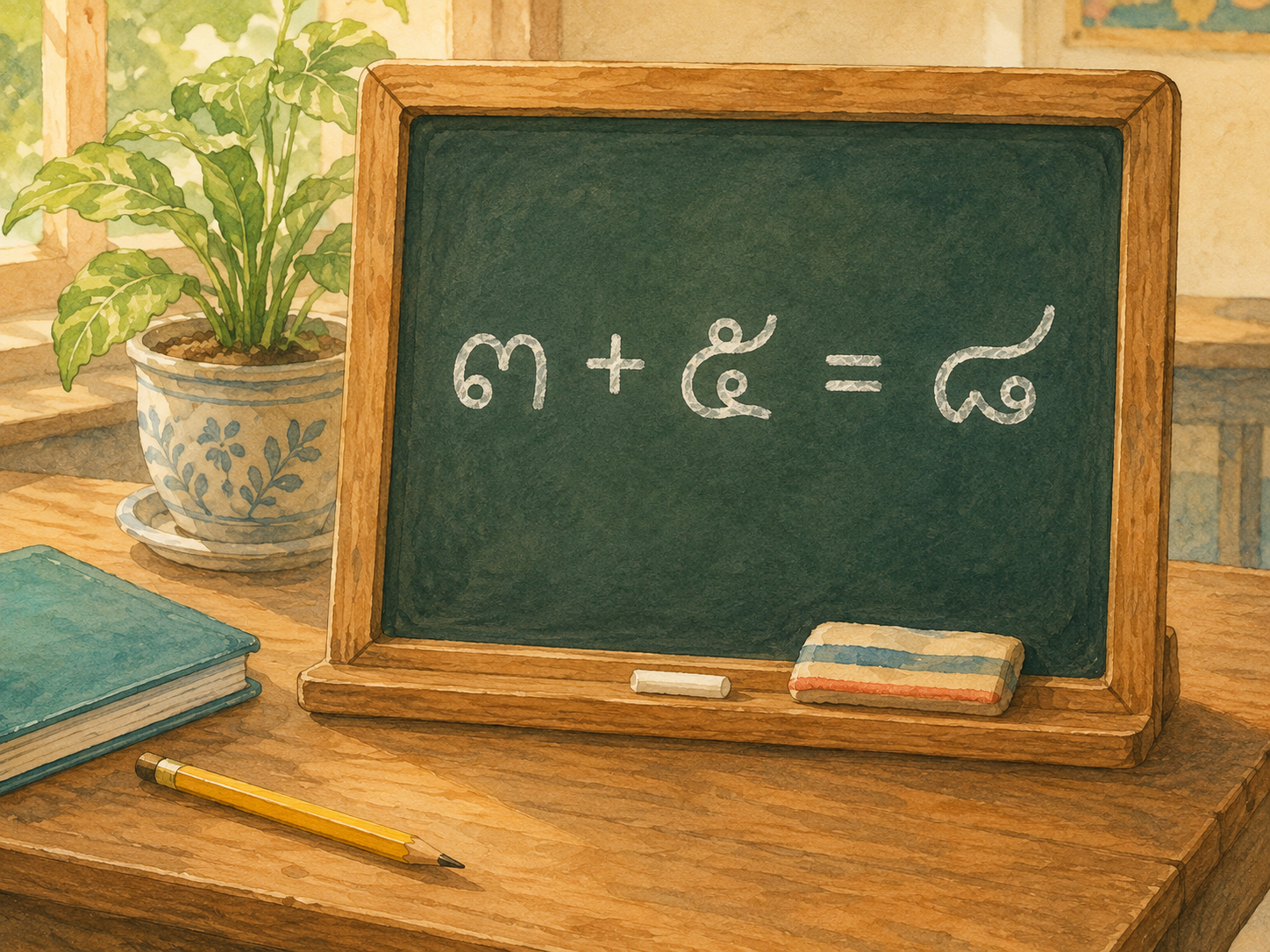
| plus (+) | บวก | bùuak | สามบวกห้าเป็นแปด — 3 + 5 = 8 |
| minus (−) | ลบ | lóp | สิบลบสี่เป็นหก — 10 − 4 = 6 |
| times (×) | คูณ | kuun | สามคูณสามเป็นเก้า — 3 × 3 = 9 |
| divided by (÷) | หาร | hǎan | สิบหารสองเป็นห้า — 10 ÷ 2 = 5 |
| equals (=) | เป็น | bpen | used after every equation |
Formal Pali-Sanskrit Numerals
Thai has a second set of number words borrowed from Pali and Sanskrit. You will not need these for everyday counting, but they appear regularly in formal documents, official titles, and compound words — so recognising them is useful even for beginners.
| Value | Pali-Sanskrit form | Transliteration | Where you see it |
|---|---|---|---|
| 1 | เอก | èek | เอกสาร (document); เอกภาพ (unity) |
| 2 | โท | too | tone mark name (ไม้โท); ปริญญาโท (master's degree) |
| 3 | ตรี | dtrii | ตรีศูล (trident); ปริญญาตรี (bachelor's degree) |
| 4 | จัตวา | jàt-dtà-waa | tone mark name (ไม้จัตวา) |
| 5 | เบญจ | bà-yèet | เบญจศีล (five Buddhist precepts); เบญจรงค์ (five-colour Thai pottery) |
Two of the four Thai tone marks — ไม้โท and ไม้จัตวา — take their names directly from this list. That connection can serve as a useful memory hook when learning the Thai tonal system.
Thai Digit Writing and Typography
Thai has its own set of digits — ๐ ๑ ๒ ๓ ๔ ๕ ๖ ๗ ๘ ๙ — which follow the same place-value system as Arabic numerals. Arabic digits appear in most informal contexts (prices, phone numbers, addresses), while Thai digits are common in formal documents, school textbooks, and traditional printing.
Punctuation conventions
- Thousands separator: a comma, identical to English — ๑,๐๐๐ (one thousand), ๑,๐๐๐,๐๐๐ (one million).
- Decimal separator: a period — ๓.๑๕ (three point one five).
- Spacing: in running Thai text, numbers written in Thai script are separated from surrounding words by a space on each side.
Because both digit systems are in daily use, fluent readers switch between them automatically. As a learner, focusing first on recognising Thai digits is more practical than memorising how to write them — you will encounter ๑ to ๙ on signs, menus, and banners throughout Thailand.